Kids Room Wall Art: Fun Prints That Grow With Them
The Heva Team
Art Curators & Interior Design Enthusiasts · February 21, 2026 · 13 min read
A complete guide to choosing wall art for children's rooms that grows with them. Covers age-appropriate art, colour psychology, safety tips, and six hand-picked canvas prints for nurseries through teen bedrooms.
Choosing wall art for a child's room feels like a high-stakes puzzle. You want something your toddler adores today that will not embarrass your ten-year-old tomorrow. The wrong pick ends up in a cupboard within a year. The right one stays on the wall through every phase, from nursery naps to homework sessions, because it taps into timeless themes like nature, imagination, and colour.
This guide walks you through age-appropriate art selection, growth-friendly design strategies, safety essentials, and the science of colour stimulation, then shows you six specific canvas prints that bridge the gap between baby room charm and big-kid sophistication. Every recommendation includes exact placement measurements so you can hang with confidence.
Ready to browse? Explore our Kids and Nursery Collection, or keep reading for our top picks and expert tips.
Age-Appropriate Art: What Works at Every Stage
A newborn's visual system processes high-contrast shapes before it can distinguish subtle colour gradients. By six months, babies recognise faces and simple animal silhouettes. Between one and three years old, children respond to bold primary colours and recognisable creatures: owls, bunnies, foxes, lambs. From ages four to seven, they start appreciating narrative scenes, characters doing things, a rabbit playing drums, a fox reading under the stars. By eight and above, abstract patterns, typography, and nature photography hold attention without feeling childish.
The smartest approach is to choose art that sits in the overlap zone: pieces detailed enough for an older child to discover new elements, yet warm and inviting enough for a toddler's first impressions. Animal portraits with botanical backgrounds hit this sweet spot perfectly. A watercolour lamb surrounded by wildflowers looks charming at age two, artistic at age eight, and vintage-cool at age fourteen.
When you are selecting sizes, keep the art proportional to the child. For a cot wall, a single 30 x 40 cm (12 x 16 inch) canvas works well. Above a toddler bed, step up to 40 x 50 cm (16 x 20 inches). For a full-size single bed, a 60 x 80 cm (24 x 32 inch) canvas or a pair of 30 x 40 cm prints creates the right visual weight. Our guide on choosing the perfect wall art size covers the maths in detail.
Growth-Friendly Choices: Art That Lasts
Growth-friendly art avoids two traps: hyper-specific licensed characters that date within a season, and ultra-minimalist abstracts that bore a young child. The enduring middle ground is nature-based illustration. Woodland animals, ocean creatures, botanical scenes, and celestial themes carry no expiry date because they connect to the real world rather than a franchise release calendar.
Look for pieces rendered in a painterly or watercolour style rather than flat cartoon graphics. A hand-painted quality gives the art substance that matures alongside the room. When a child transitions from a cot to a desk, the same owl portrait that once served as a soothing bedtime companion becomes an elegant accent above a bookshelf.
Frame colour matters too. Black or espresso frames read more grown-up and transition seamlessly into teen years. White frames keep the feel light and nursery-appropriate but can look too delicate in a room with darker furniture. Natural wood splits the difference and suits almost every stage. All our framed canvas prints come in four frame options, so you can match the room as it evolves.
Themed groupings also extend the lifespan of your investment. A trio of woodland animals (an owl, a fox, and a badger) can be rearranged or separated as the child's taste shifts. Start with all three above the cot, move one to the reading nook at age five, and scatter them across the room by age ten. The art stays relevant because the arrangement keeps changing.
Safety Considerations for Kids Room Decor
Safety in a child's room goes beyond sharp corners. Wall art must be securely mounted so a curious toddler cannot pull it down. Framed canvas prints are lighter than glass-fronted frames, which makes them safer and easier to hang with standard picture hooks rated for 4.5 kg (10 pounds).
Mounting height matters for safety as well as aesthetics. In a nursery, hang art at adult eye level, roughly 150 cm (59 inches) from the floor to the centre of the canvas. This keeps it well out of cot-climbing range. In a toddler's room, you can lower it to 120 cm (47 inches), which lets them enjoy it while standing but keeps it above grab height when furniture is pulled close. For school-age children, hang at their seated eye level if it is near a desk, typically 100 to 110 cm (39 to 43 inches).
Material safety is equally important. Canvas prints avoid the shatter risk of glass entirely. Look for prints made with eco-friendly, water-based inks on FSC-certified materials. Our matte canvas prints use archival-quality inks that are solvent-free, making them a safe choice for nurseries and children's bedrooms. For detailed hanging instructions, see our complete guide to hanging wall art.
Colour Stimulation and Child Development
Research in environmental psychology shows that the colours surrounding a child influence mood, focus, and even sleep quality. Cool-spectrum tones like soft blue, sage green, and lavender activate the parasympathetic nervous system, lowering cortisol and heart rate. These are ideal for bedrooms where calm and rest matter most. Warm tones like golden yellow, terracotta, and coral stimulate dopamine pathways that encourage energy, creativity, and social interaction, making them excellent for playrooms and reading corners (Kids Interiors).
The practical takeaway: choose wall art with a dominant colour that matches the energy you want in that specific zone. A dusty blue owl painting beside the bed supports winding down. A vibrant botanical print near the toy area signals playtime. You do not need to repaint walls to shift the mood. Strategically placed canvas art introduces targeted colour without permanent commitment.
Contrast matters for cognitive development too. Babies under six months are drawn to high-contrast edges (think dark animals against light backgrounds). Between six months and two years, moderate contrast with two or three colours holds attention best. After age two, richer palettes with five to seven colours encourage colour-naming skills and visual discrimination. Our deeper exploration in The Psychology of Colors in Wall Art covers every hue and its emotional effect.
Wall art can also serve as a subtle educational tool. A piece featuring a night sky with moons and stars invites conversations about space. An underwater scene with a seahorse teaches marine biology vocabulary. Even a simple lamb-and-wildflower composition introduces botanical names and seasonal concepts. The key is choosing art detailed enough to spark questions, because a curious child standing in front of a canvas asking "what flower is that?" is learning without realising it (Square Signs).
Our 6 Top Picks for Kids Room Wall Art
1. Moon Owl Celestial Oil Painting Nursery Canvas
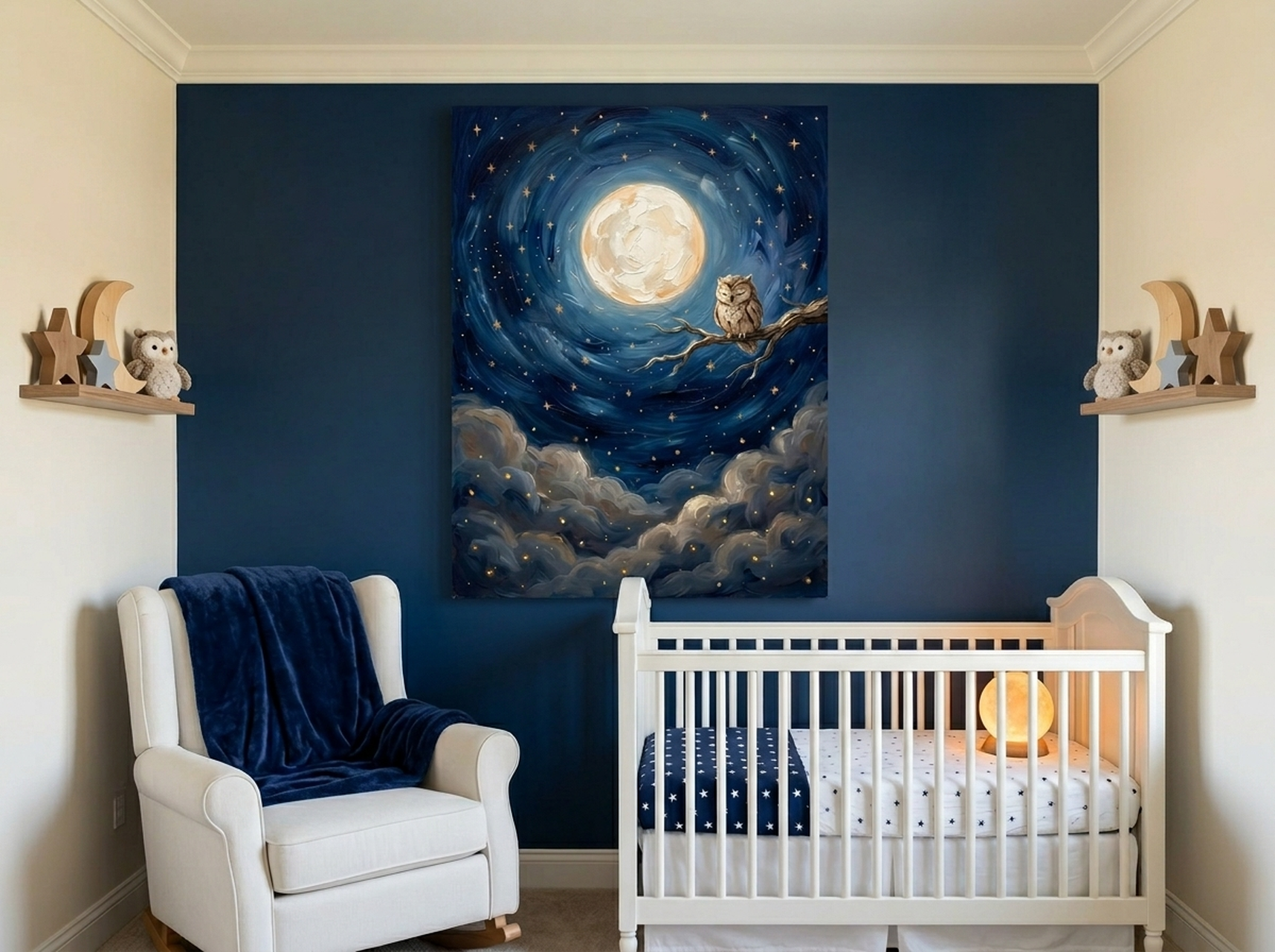
This celestial owl sits on a moonlit branch against a deep indigo sky scattered with stars. The palette of navy, gold, and soft cream creates a calming atmosphere perfect for bedtime. Hang it above the cot or beside a rocking chair to establish a soothing nighttime routine. The painterly brushwork gives it a museum quality that looks equally at home in a toddler nursery or a pre-teen's constellation-themed room. The rich contrast between the owl's warm feathers and the cool night sky also makes it an excellent first focal point for a newborn developing visual tracking.
View the Moon Owl Celestial Canvas
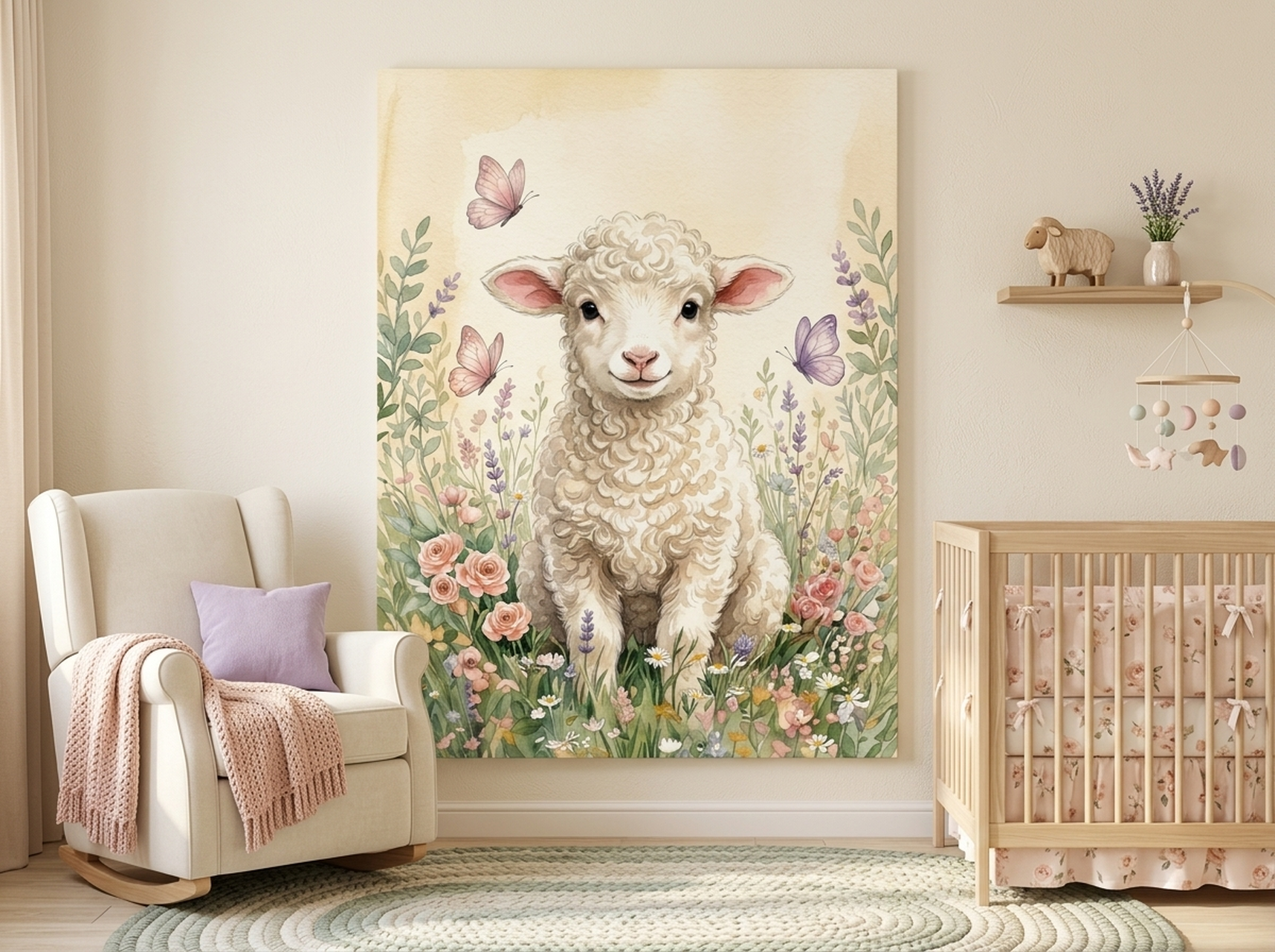
2. Baby Lamb Wildflower Watercolor Nursery Canvas
Soft watercolour washes of blush pink, sage green, and butter yellow surround a gentle lamb nestled among wildflowers. This piece radiates calm without being saccharine. It suits a gender-neutral nursery beautifully and pairs well with natural wood furniture and linen textiles. The botanical detail, individual petals and leaf veins are visible, gives older children something to study up close, while the overall softness keeps it nursery-friendly. Place it at the centre of a gallery trio or let it stand alone above a changing table at 150 cm (59 inches) from floor to centre.
View the Baby Lamb Wildflower Canvas
3. Balloon Bunny Watercolor Nursery Canvas
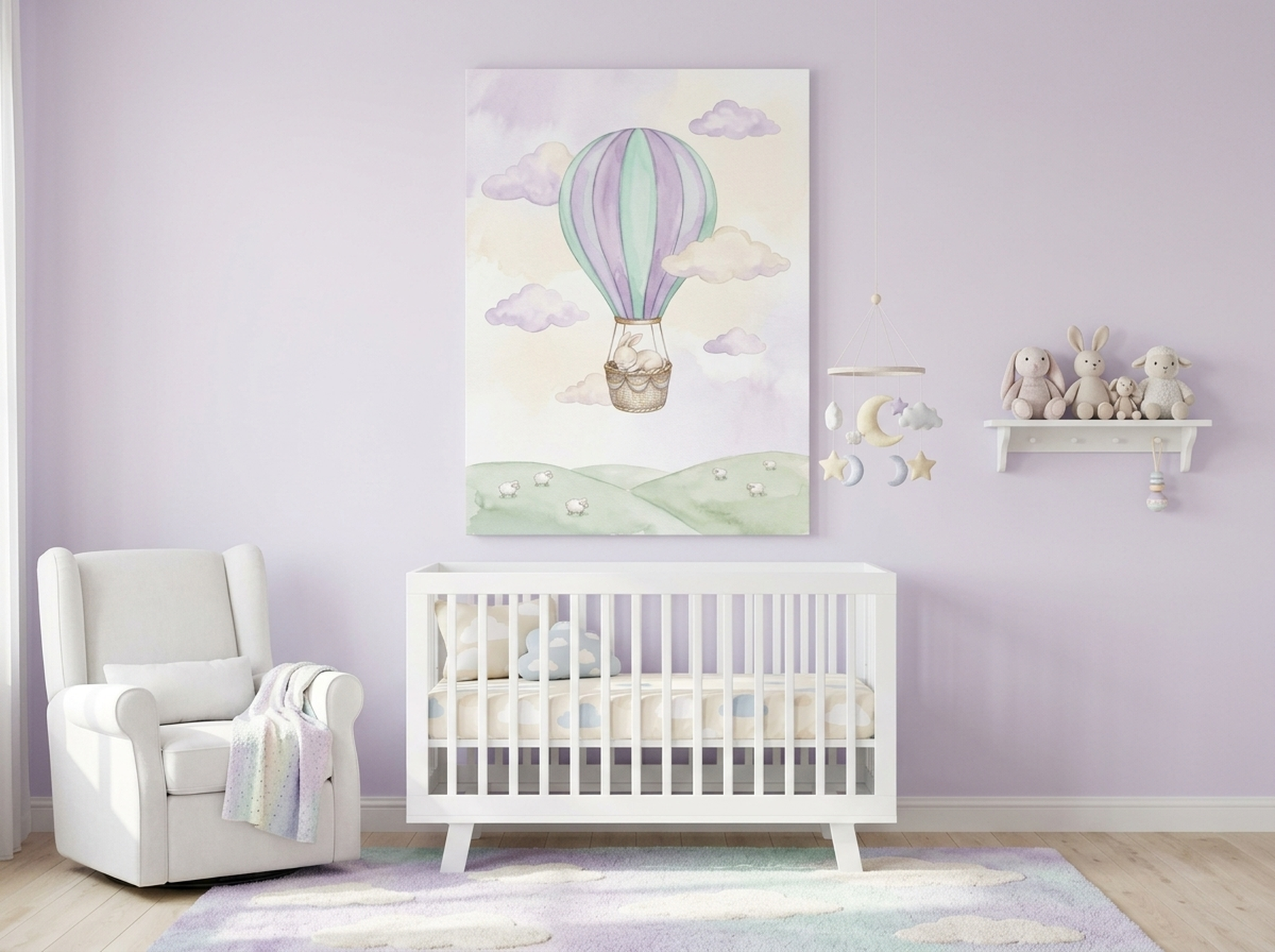
A whimsical bunny drifts upward holding a cluster of pastel balloons against a dreamy lavender sky. This piece captures the magic of imagination and adventure, themes that resonate from infancy through early childhood. The colour story of lavender, soft coral, and cloud white makes it a natural fit for a nursery with muted, Scandinavian-inspired decor. At 60 x 80 cm (24 x 32 inches), it fills the wall space above a single bed or reading nook without overwhelming the room. The upward motion of the composition draws the eye and adds a sense of height to rooms with low ceilings.
4. Fox Reading by Starlight Whimsical Nursery Canvas
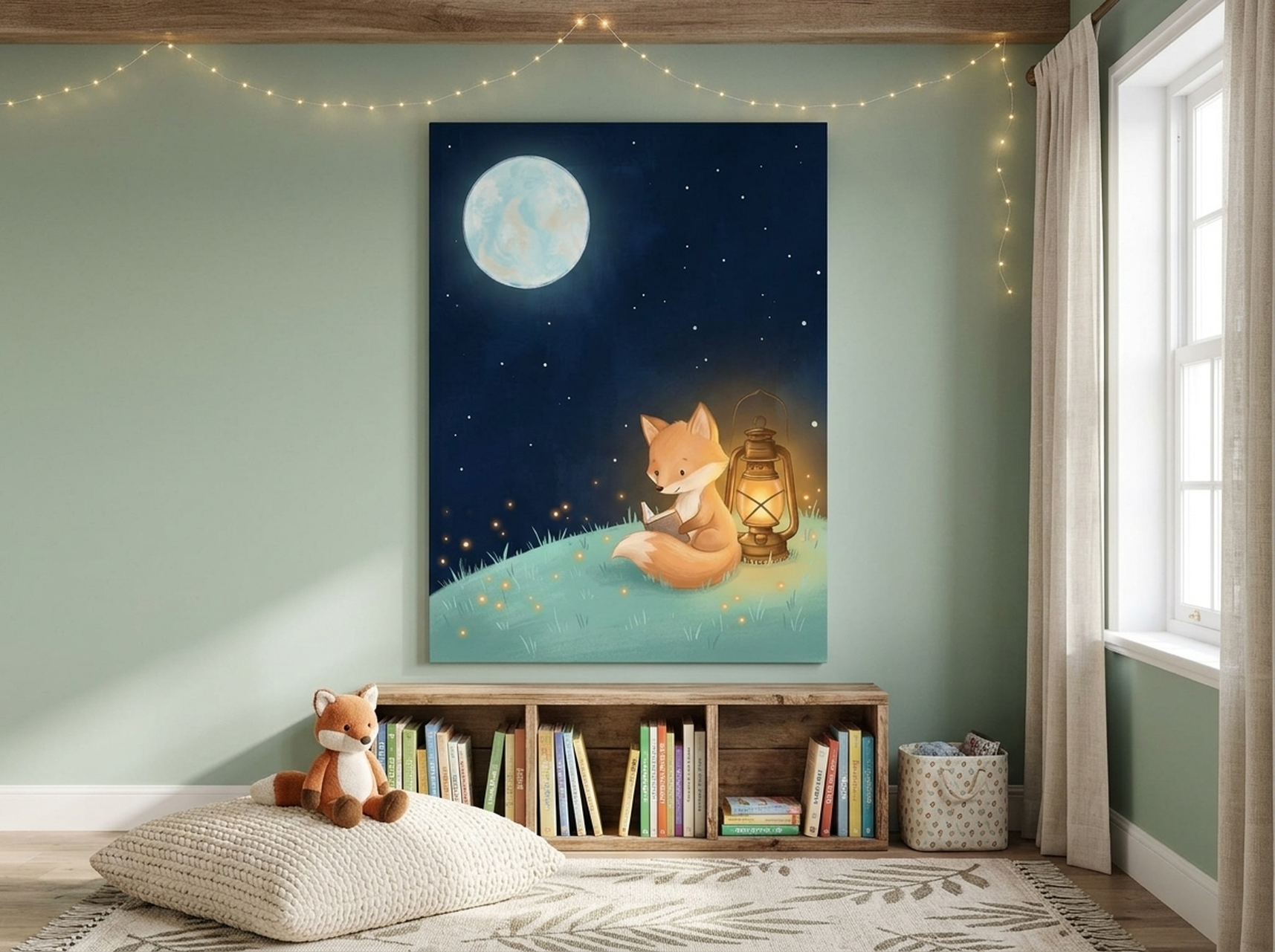
A fox curled up with a book under twinkling stars speaks directly to every child who loves bedtime stories. The warm amber glow of the reading light contrasts with the cool forest greens and midnight blues of the surrounding woodland, creating a cosy, intimate atmosphere. This is a piece that actively encourages reading, making it ideal for a book nook or next to a child's bookshelf. The narrative element (an animal doing a human activity) appeals especially to children aged three to eight, who are deep in their imaginative-play years. Pair it with the Moon Owl for a woodland-night gallery wall that tells a cohesive story.
View the Fox Reading by Starlight Canvas
5. Triceratops Watercolor Nursery Canvas
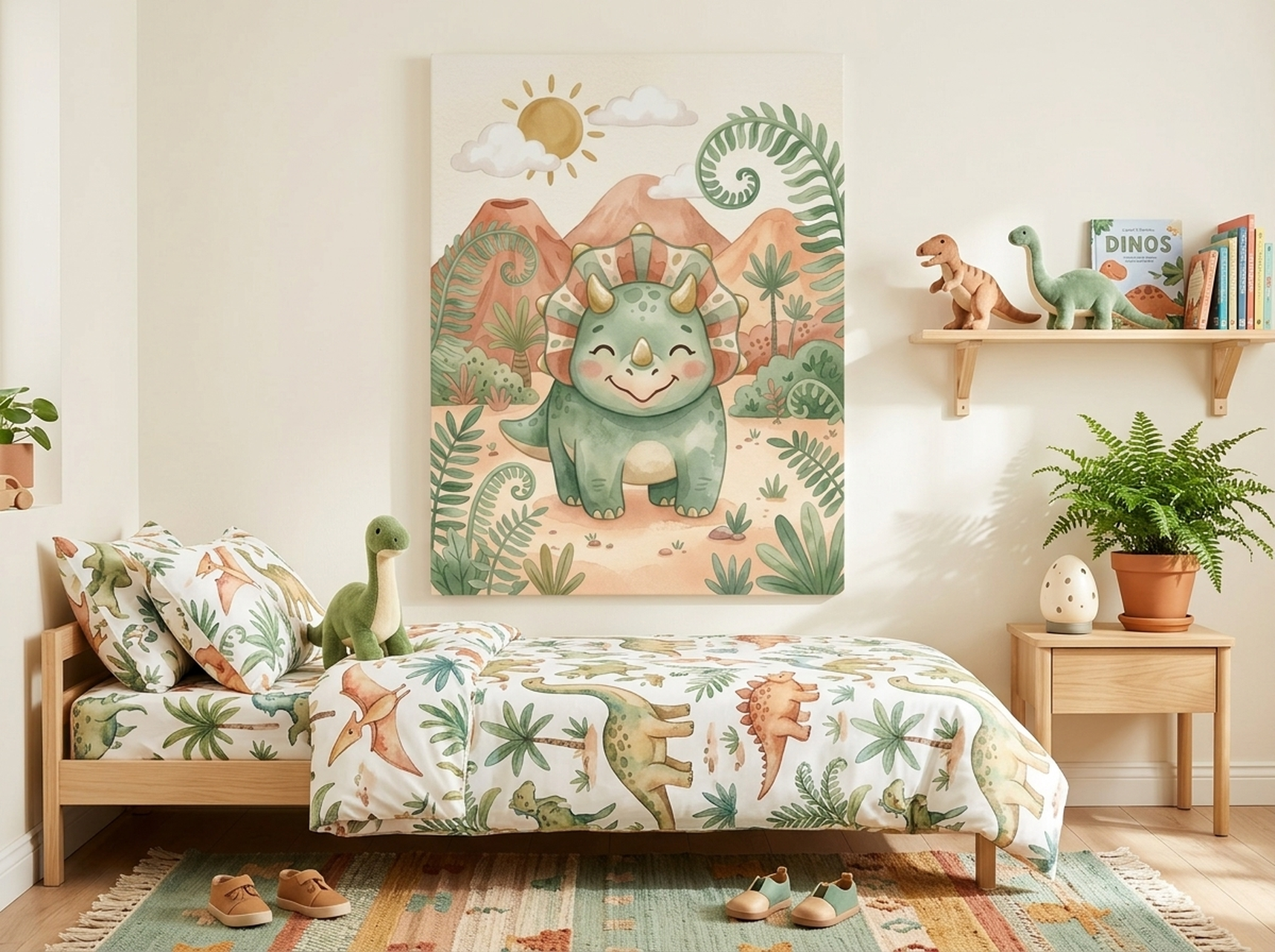
Dinosaur art is a category of its own in children's rooms, and this watercolour triceratops gets the tone exactly right. Instead of a cartoonish character, you get a gently rendered, scientifically recognisable dinosaur in soft earthy greens and warm browns surrounded by prehistoric botanicals. It satisfies a dinosaur-obsessed four-year-old while looking refined enough for a nine-year-old who has moved on to palaeontology books. The muted botanical background ensures it coordinates with virtually any colour scheme. Hang it at desk height, about 100 cm (39 inches) to centre, so your budding scientist can study it while doing homework.
View the Triceratops Watercolor Canvas
6. Rabbit Drummer Folk Art Nursery Canvas
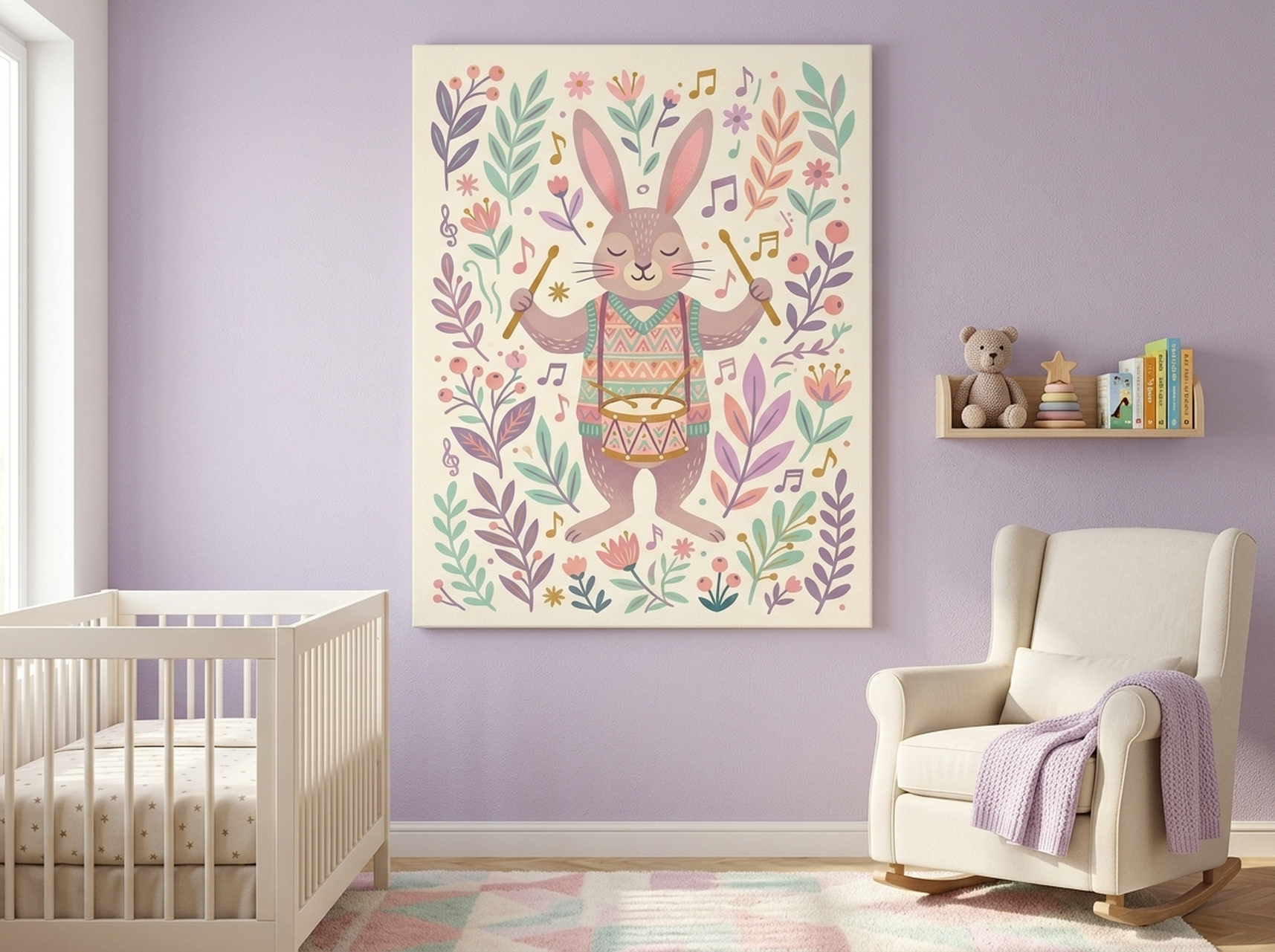
A rabbit playing a drum with folk-art flair brings energy, rhythm, and personality to any kids room. The earthy palette of terracotta, forest green, and mustard yellow gives it a handcrafted, artisan quality that feels collected rather than mass-produced. This piece works brilliantly in a music-themed room or as the playful counterpoint in a woodland gallery wall. The folk-art style bridges the gap between nursery illustration and decorative art, meaning it stays on the wall long after the nursery phase ends. Position it in a play area at 90 to 100 cm (35 to 39 inches) from floor to centre, where a toddler can point at it during music time.
View the Rabbit Drummer Canvas
Arrangement Guide: Hanging Art in a Child's Room
The golden rule for kids room arrangements is simplicity. One strong focal piece above the bed beats a cluttered collage every time. If you want a gallery wall, limit it to three pieces maximum and keep them within a single horizontal band no more than 120 cm (47 inches) wide.
Single statement piece. Centre the canvas above the headboard with 15 to 20 cm (6 to 8 inches) of space between the top of the headboard and the bottom edge of the frame. The canvas should be roughly two-thirds the width of the bed. For a standard single bed at 90 cm (36 inches) wide, a 60 cm (24 inch) wide canvas is ideal.
Symmetrical pair. Choose two complementary pieces (for example, the Baby Lamb and the Fox Reading by Starlight). Hang them side by side with 5 to 8 cm (2 to 3 inches) between frames. The pair should together span about two-thirds of the furniture width below them.
Asymmetrical trio. Place the largest canvas (60 x 80 cm / 24 x 32 inches) off-centre, then add two smaller pieces (30 x 40 cm / 12 x 16 inches each) stacked vertically beside it. Keep 5 cm (2 inches) between all edges. This arrangement works above a dresser or bookcase and adds visual interest without requiring precise symmetry.
Reading nook accent. In a corner reading area, hang one canvas at the child's seated eye level, roughly 80 to 90 cm (31 to 35 inches) from the floor. The Fox Reading by Starlight is the obvious choice here as it reinforces the purpose of the space and makes the nook feel intentional.
5 Common Mistakes to Avoid
1. Choosing licensed characters over timeless themes. A cartoon character from this year's hit show will feel dated within two seasons. Animals, nature, and abstract patterns never go out of style because they are not tied to a marketing cycle. Invest in art your child will still like at age twelve.
2. Hanging art too high. Adults default to their own eye level, which is 150 cm (59 inches) from the floor. In a child's room where the child spends most of their time sitting or lying down, the centre of the art should be closer to 100 to 120 cm (39 to 47 inches). The exception is the nursery, where you hang at adult level to keep it away from climbing toddlers.
3. Ignoring colour energy. Hanging a bright red or electric orange canvas next to the bed may look striking in a photo, but it can overstimulate a child at bedtime. Reserve warm, high-energy colours for play zones and stick to cool blues, greens, and lavenders near the sleep area.
4. Overcrowding the walls. More art does not mean a better room. Three well-chosen pieces with breathing room between them create a calmer, more visually organised space than eight random prints crammed edge to edge. White space on the wall is restful for a child's developing visual system.
5. Forgetting to update the arrangement. Even timeless art benefits from a refresh every year or two. Move pieces between rooms, swap positions, or add a single new canvas to mark a milestone birthday. The art stays the same, but the layout keeps the room feeling new without the cost of replacing everything.
Frequently Asked Questions
What is the best wall art size for a small kids room?
For a room under 10 square metres (108 square feet), a single 40 x 50 cm (16 x 20 inch) canvas is your best bet. It provides visual impact without shrinking the space. If the room has one long unbroken wall, you can go up to 60 x 80 cm (24 x 32 inches). Avoid gallery walls in very small rooms because the visual clutter makes them feel even smaller.
How do I choose colours for nursery wall art?
Start with the room's main wall colour and pick art that introduces one or two complementary accent tones. For a white or cream nursery, almost anything works. For a sage green nursery, look for art featuring warm accents like blush pink, gold, or terracotta. For a navy nursery, celestial themes with gold and cream create a harmonious palette. The art should add colour interest, not compete with the walls.
Is canvas wall art safe for a baby's room?
Yes. Canvas prints are one of the safest options for nurseries because they contain no glass that could shatter if pulled from the wall. Framed canvas prints are lightweight (typically under 2 kg / 4.4 pounds) and can be secured with standard picture hooks. For extra security, add adhesive bumper pads to the bottom corners to prevent the frame from shifting.
Can I wash or clean canvas wall art?
Dust canvas prints with a soft, dry microfibre cloth every few weeks. For fingerprints or light marks (inevitable in a kids room), dampen the cloth slightly with water and blot gently. Avoid chemical cleaners, sprays, or abrasive cloths as they can damage the matte finish. Archival-quality inks are fade-resistant, so the print will stay vibrant for years with minimal maintenance.
How many pieces of wall art does a kids room need?
One to three pieces is the sweet spot. A single large canvas above the bed creates a clean focal point. Two complementary pieces create balance. Three pieces (a trio of themed prints) offer variety without visual chaos. Going beyond three pieces in a standard kids room risks overstimulation. Save the gallery-wall approach for hallways or playrooms where visual density is welcome.
At what age should I start putting art on my child's walls?
From birth. Newborns begin tracking high-contrast shapes within weeks, and by three months they are actively studying visual patterns on the wall. Placing a canvas with strong contrast (dark figures on a light background) within 30 to 60 cm (12 to 24 inches) of the cot gives a newborn something meaningful to focus on during awake time. Just ensure it is mounted securely at adult height so the baby cannot reach it.
Quick Reference Table
| Product | Best For | Dominant Colours | Link |
|---|---|---|---|
| Moon Owl Celestial | Nursery sleep zone, bedtime calm | Navy, gold, cream | View |
| Baby Lamb Wildflower | Gender-neutral nursery, changing area | Blush pink, sage, butter yellow | View |
| Balloon Bunny Watercolor | Reading nook, Scandi nursery | Lavender, coral, cloud white | View |
| Fox Reading by Starlight | Book nook, story-time corner | Amber, forest green, midnight blue | View |
| Triceratops Watercolor | Dinosaur room, desk area | Earthy green, warm brown, cream | View |
| Rabbit Drummer Folk Art | Playroom, music corner | Terracotta, forest green, mustard | View |
Start Building Their Dream Room
Every canvas in our Kids and Nursery collection ships framed and ready to hang, with free US delivery. Choose from four frame colours to match any room, any stage, any story your child wants to live in.