Canvas vs Paper Prints for Living Room Wall Art
The Heva Team
Art Curators & Interior Design Enthusiasts · January 29, 2026 · 14 min read
Canvas or paper prints for your wall art? Compare quality, durability, cost, and visual impact to decide which format works best for your home decor.
You have found the perfect image for your wall, but now comes the harder question: should you print it on canvas or paper? The answer affects everything from how your art looks in natural light to how long it lasts before fading. This guide breaks down every difference that actually matters, with specific measurements, durability data, and real product examples, so you can spend your budget on the right material the first time.
Quick answer: For most living spaces, framed matte canvas prints offer better durability, richer texture, and a more premium look. Paper prints work best for temporary displays, rotating galleries, or tight budgets.
Ready to browse? Explore our full canvas wall art collection, or keep reading for our top picks and expert tips.
Material Comparison: Canvas vs Paper at a Glance
Canvas and paper are fundamentally different surfaces, and each one changes how the same image looks on your wall. Canvas is a woven fabric, traditionally made from cotton or polyester, stretched taut over a wooden stretcher frame. The weave creates a subtle texture that softens fine details and adds a tactile, painterly quality. Paper prints, by contrast, use a smooth or lightly textured cellulose surface that preserves sharp lines and intricate detail with precision.
The practical differences break down into five areas that matter most for wall art buyers:
- Texture: Canvas has a visible weave pattern that mimics traditional oil paintings. Paper is smooth or semi-smooth, better suited to photography and fine-line illustration.
- Weight and rigidity: A stretched canvas on a 2 cm (0.8 inch) deep frame is self-supporting and ready to hang. Paper prints need a separate frame and backing board, adding 0.5 to 1.5 kg (1 to 3 pounds) of weight.
- Glare: Matte canvas produces virtually zero glare under direct light. Paper prints behind glass can create mirror-like reflections, especially in rooms with south-facing windows, unless you invest in anti-reflective glass, which typically adds 30 to 50 percent to the framing cost.
- Touch: Canvas feels textured and substantial when you run a finger across it. Paper behind glass is untouchable by design.
- Perceived value: Interior designers consistently rank canvas prints as looking more premium and gallery-like on walls, according to home decor surveys from major design platforms.
For a deeper look at how print format affects your space, see our guide on canvas wall art vs framed prints.
Durability and Longevity
If you are spending money on wall art, you want it to last. Here is how canvas and paper compare when it comes to standing the test of time.
Fade resistance. Modern archival canvas prints using pigment-based inks can last 75 to 100 years before noticeable fading when displayed away from direct sunlight. Paper prints with the same ink technology typically last 50 to 80 years under similar conditions, but they are more vulnerable to UV damage because the ink sits closer to the surface. Hanging art on a wall that receives direct afternoon sun can cut these estimates by 30 to 50 percent for either material, so placement matters. As 365Canvas notes in their canvas versus paper comparison, canvas generally offers a longer display life for everyday home environments.
Moisture tolerance. Canvas handles humidity better than paper. In a bathroom with moderate humidity (50 to 70 percent relative humidity), an uncoated paper print can warp or buckle within months. Canvas, especially when stretched and coated with a protective laminate, resists warping far more effectively. That said, neither material is suitable for direct water exposure.
Physical durability. A stretched canvas absorbs minor bumps and vibrations, as from a nearby door slamming, without damage. A paper print behind glass can crack or shatter under the same impact, potentially ruining both the glass and the print. Canvas also resists dust accumulation better than glass, which shows fingerprints and static-attracted particles within days.
The bottom line: For long-term display in a living room, bedroom, or dining room, canvas is the more durable choice. Paper prints make sense for rotating displays where you plan to swap art every few months.
Colour Vibrancy and Detail Reproduction
This is where the canvas-versus-paper debate gets nuanced, because each material has a genuine advantage in different scenarios.
Canvas excels at: warm tones, gradients, and painterly subjects. The woven texture diffuses light slightly, which produces richer mid-tones and smoother transitions between colours. Landscapes, portraits, abstract art, and any subject that benefits from a soft, organic feel will look better on canvas. A sunset gradient that might show visible banding on glossy paper will appear seamless on canvas.
Paper excels at: fine detail, sharp edges, and photographic precision. If your art features tiny text, architectural line work, or ultra-high-resolution photography where you want to count individual eyelashes, paper preserves those details more faithfully. The smooth surface means ink droplets stay exactly where they land, with no texture to soften them.
For the vast majority of wall art buyers, that trade-off favours canvas, because most wall art is viewed from 1.5 to 3 metres (5 to 10 feet) away, and at that distance, the micro-detail advantage of paper is invisible while the textural richness of canvas is clearly apparent. According to Juniper Print Shop's comparison of paper versus canvas, the tactile surface of canvas adds a dimension of depth that paper simply cannot match at normal viewing distances.
Matte canvas also avoids the colour-shift problem that glossy paper exhibits at oblique viewing angles. If your sofa is off-centre from the art, a glossy paper print may look washed out from one side. Canvas maintains consistent colour from every angle in the room.
Framing and Display Options
How you frame your art changes both the look and the total cost. Canvas and paper each have different framing requirements.
Canvas prints arrive stretched on a wooden frame, typically 2 to 4 cm (0.8 to 1.6 inches) deep, and are ready to hang immediately. You can display them with or without an outer frame. Adding a floating frame (a slim border that sits about 3 mm or 0.12 inches away from the canvas edge) creates a polished, gallery look without glass. Total framing cost for canvas: often zero, since the stretcher frame is built in.
Paper prints require a mat board, backing board, glass or acrylic glazing, and a frame. A quality custom frame job for a 61 by 91 cm (24 by 36 inch) paper print typically costs between 80 and 250 dollars, depending on the frame material and glass quality. Anti-reflective museum glass alone can run 60 to 120 dollars for that size. Budget frames from big-box stores cost less but often look and feel cheap, undermining the print quality.
For tips on getting the proportions right, our guide to choosing wall art sizes covers the two-thirds rule, eye-level placement, and furniture-to-art ratios in detail.
Cost and Long-Term Value
At first glance, paper prints look cheaper, and they are, at the point of purchase. A paper print typically costs 30 to 50 percent less than an equivalent canvas print. But that comparison is misleading because it ignores the total cost of display.
| Cost Factor | Canvas Print | Paper Print |
|---|---|---|
| Print cost (61 x 91 cm / 24 x 36 in) | Higher | Lower |
| Framing cost | Included (stretcher frame) | $80 to $250 additional |
| Anti-reflective glass | Not needed | $60 to $120 additional |
| Display lifespan | 75 to 100 years | 50 to 80 years |
| Humidity resistance | Good | Poor without glass |
| Ready to hang | Yes, immediately | No, needs framing |
When you add framing and glass to a paper print, the total cost often exceeds that of a ready-to-hang canvas. And canvas requires no additional glass cleaning, no risk of glass breakage during moves, and no reframing if you change decor styles. For most buyers, canvas is the better long-term investment.
Our 6 Canvas Picks That Prove the Difference
Each of these pieces showcases a different reason why canvas outperforms paper for wall art. From landscapes that gain depth to abstracts that gain texture, these are real examples from our collection that illustrate the canvas advantage perfectly.
1. Norwegian Fjord Mountain Landscape
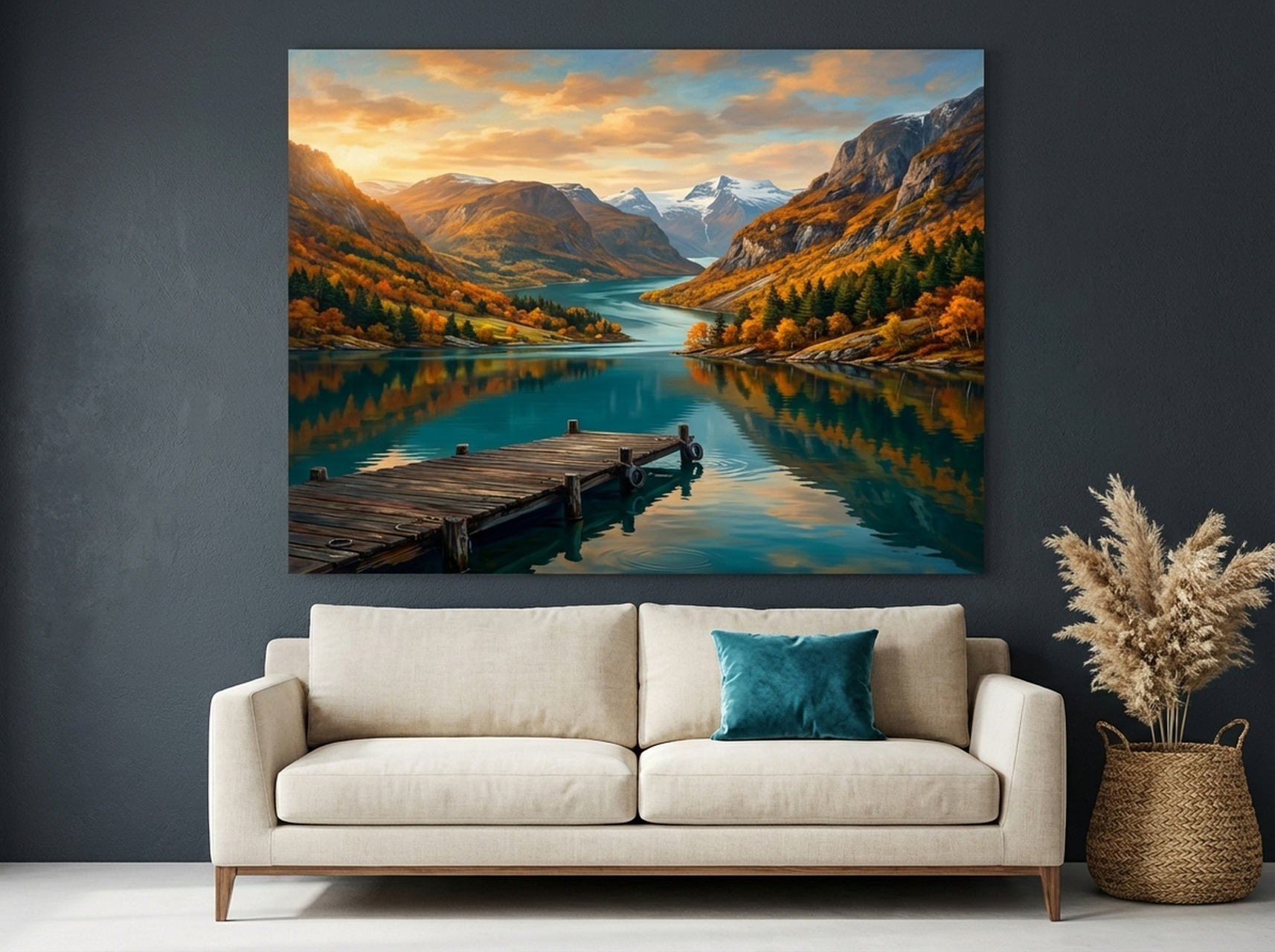
This sweeping Norwegian fjord scene captures the kind of atmospheric depth that canvas was born to display. The layered blues and burnt oranges of the water and foliage gain a painterly softness on matte canvas that paper simply cannot replicate. Hang it above a sofa as a 61 by 91 cm (24 by 36 inch) statement piece, and the woven texture will catch sidelight from nearby windows, adding a subtle shimmer that changes throughout the day. Ideal for Scandinavian-style living rooms, coastal retreats, or any space where you want guests to feel transported.
View the Norwegian Fjord Mountain Landscape
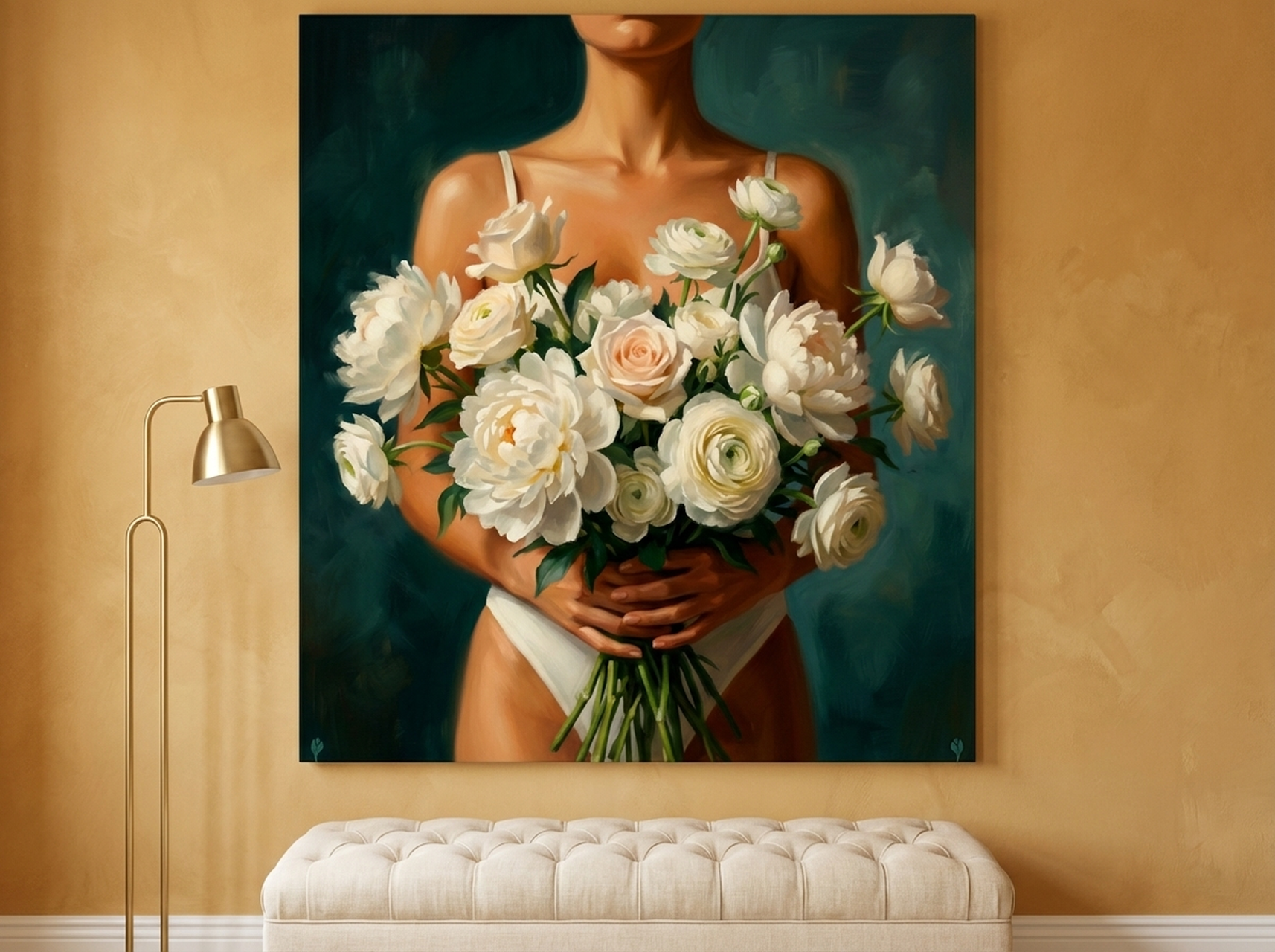
2. Floral Figure Oil Painting
Delicate white peonies frame a vintage editorial figure against a rich teal background in this romantic canvas print. The matte finish softens the brush strokes just enough to feel like an original oil painting, while the colours stay vivid even in low-light bedrooms. At 51 by 76 cm (20 by 30 inches) it fits beautifully above a nightstand or dressing table. The teal-and-cream palette pairs naturally with brass hardware, linen bedding, and warm wood tones for a curated, gallery-worthy look.
View the Floral Figure Oil Painting
3. Roaring Lion Matte Canvas Print
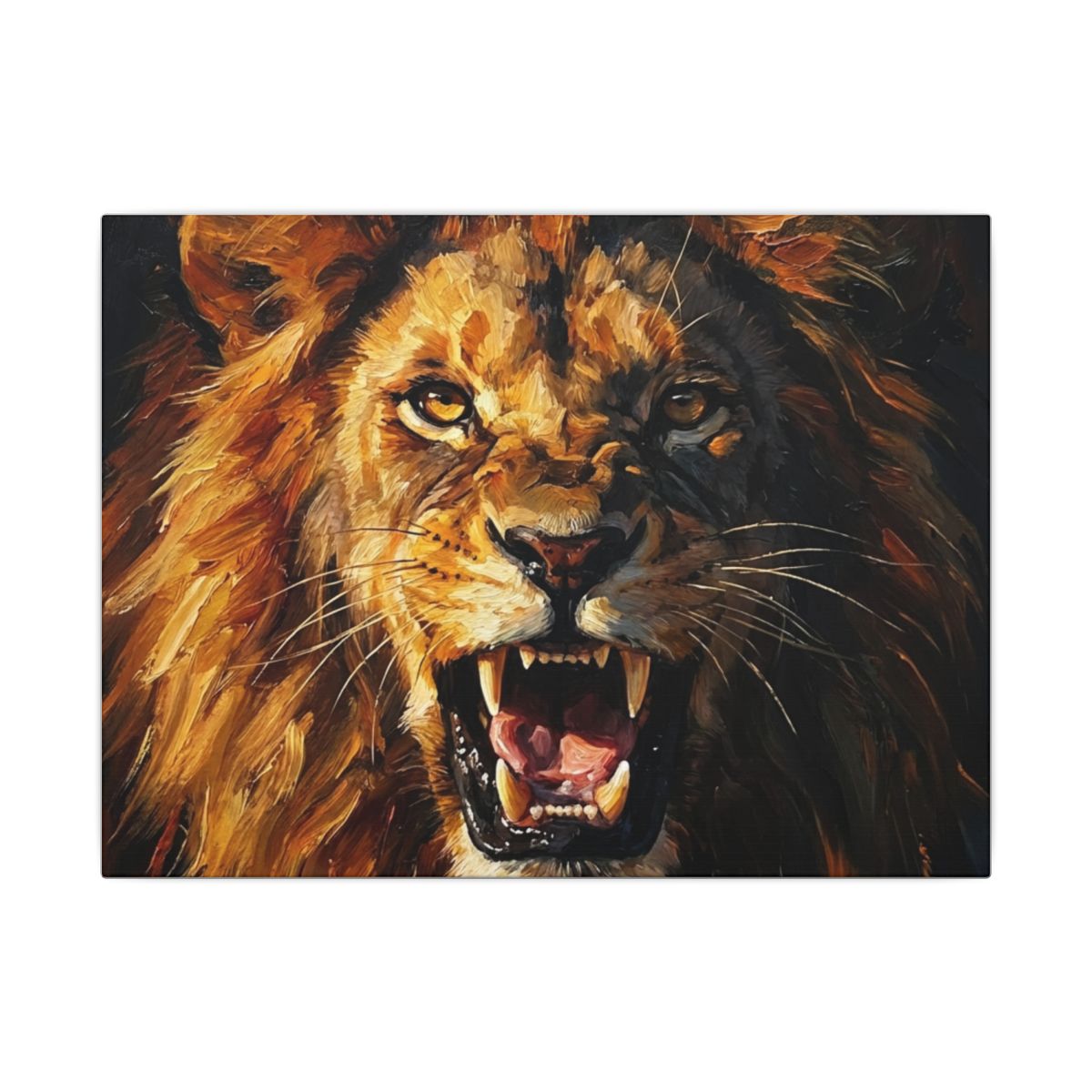
Few subjects demonstrate the power of canvas texture quite like wildlife art, and this roaring lion is a perfect example. The matte surface eliminates the glare you would get from a glass-framed paper print, letting the deep blacks and fiery golds command attention without distraction. Canvas also handles the high-contrast transition between the lion's dark mane and the warm amber background more gracefully than glossy paper, which can show banding in gradient areas. Mount it in a home office or media room at 61 by 81 cm (24 by 32 inches) for maximum impact.
View the Roaring Lion Matte Canvas Print
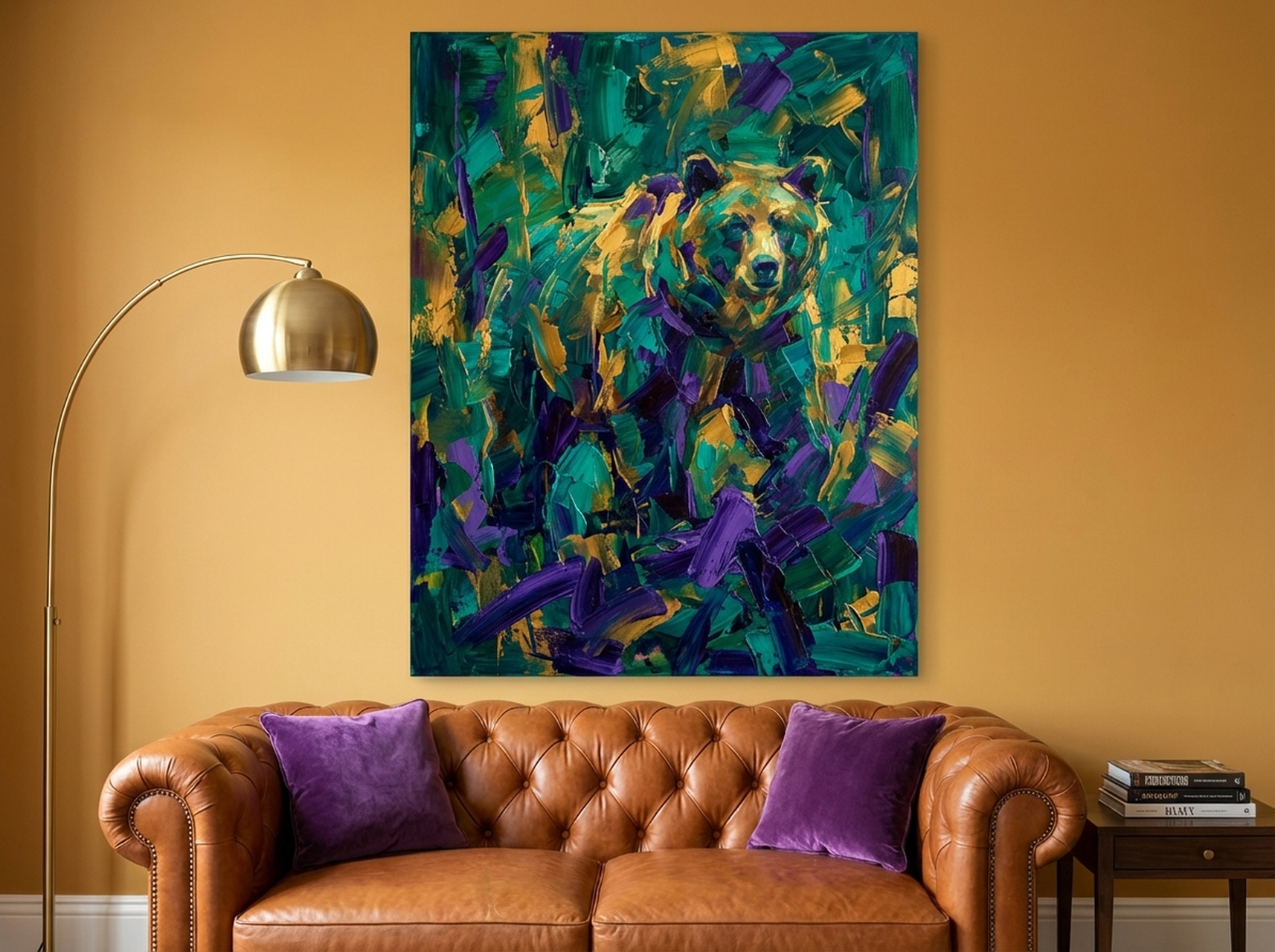
4. Abstract Grizzly Bear Emerald Gold
Abstract expressionist brushwork and a jewel-tone palette of emerald, gold, and purple make this grizzly bear print a conversation starter in any room. On canvas, the thick impasto-style strokes look convincingly three-dimensional because the woven surface adds micro-texture that a flat paper print lacks. The colours shift subtly under warm versus cool lighting, giving the piece a dynamic quality that rewards repeated viewing. Place it in a hallway at 41 by 61 cm (16 by 24 inches) or as part of a gallery wall to anchor bolder decor choices.
View the Abstract Grizzly Bear Emerald Gold
5. Moroccan Medina Lantern Alley
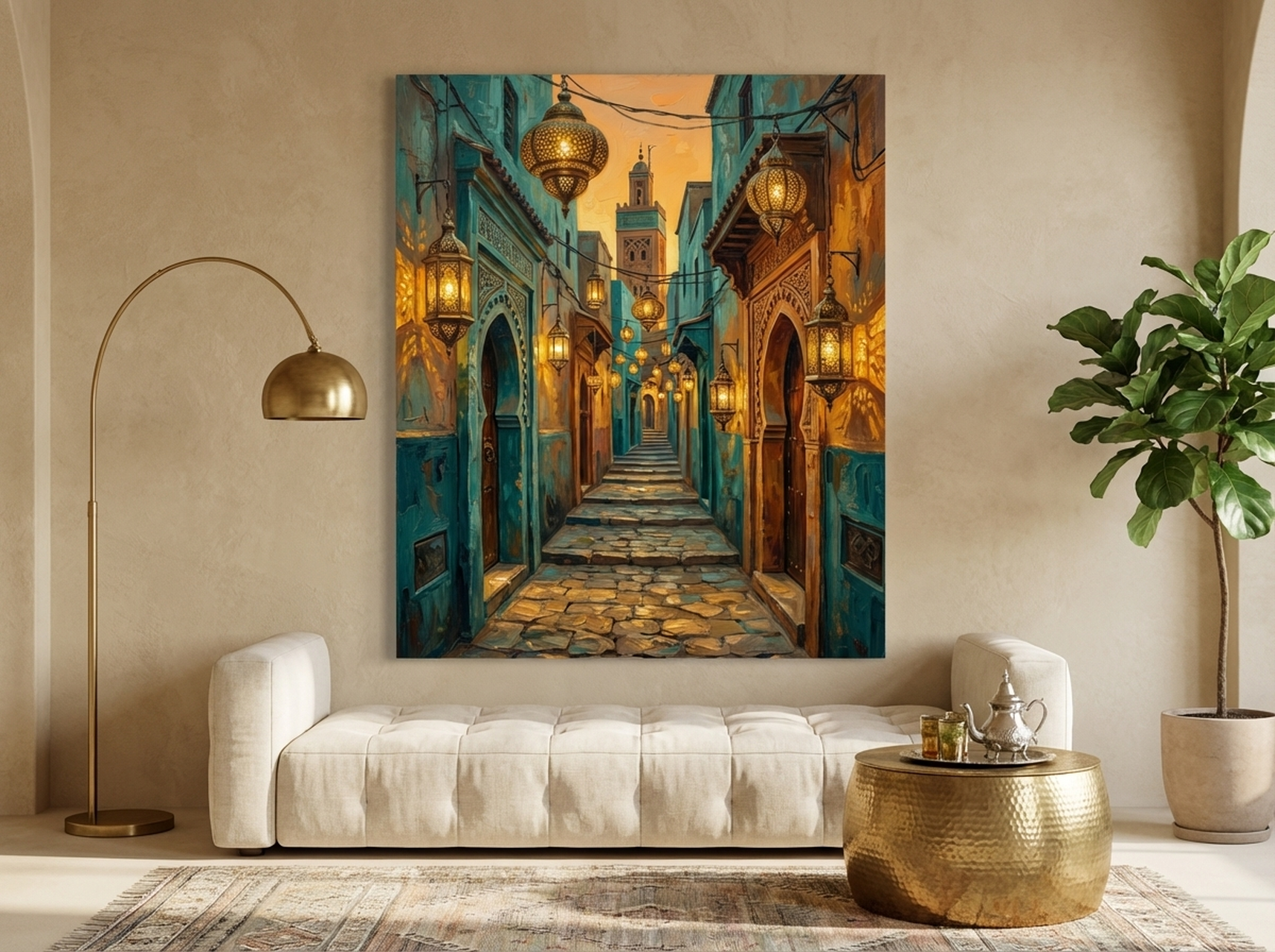
Walk through a lantern-lit Moroccan alley without leaving your dining room. The warm saffron and cool teal tones of this oil-painting-style canvas print create an inviting atmosphere that works especially well in spaces where you entertain. Canvas texture enhances the painted quality of the architecture and the soft glow of the hanging lanterns, making it feel less like a print and more like a collected original. Size it at 51 by 76 cm (20 by 30 inches) and pair with terracotta accessories and woven textiles for a globally inspired look.
View the Moroccan Medina Lantern Alley
6. Wolf Moonlit Forest Painting
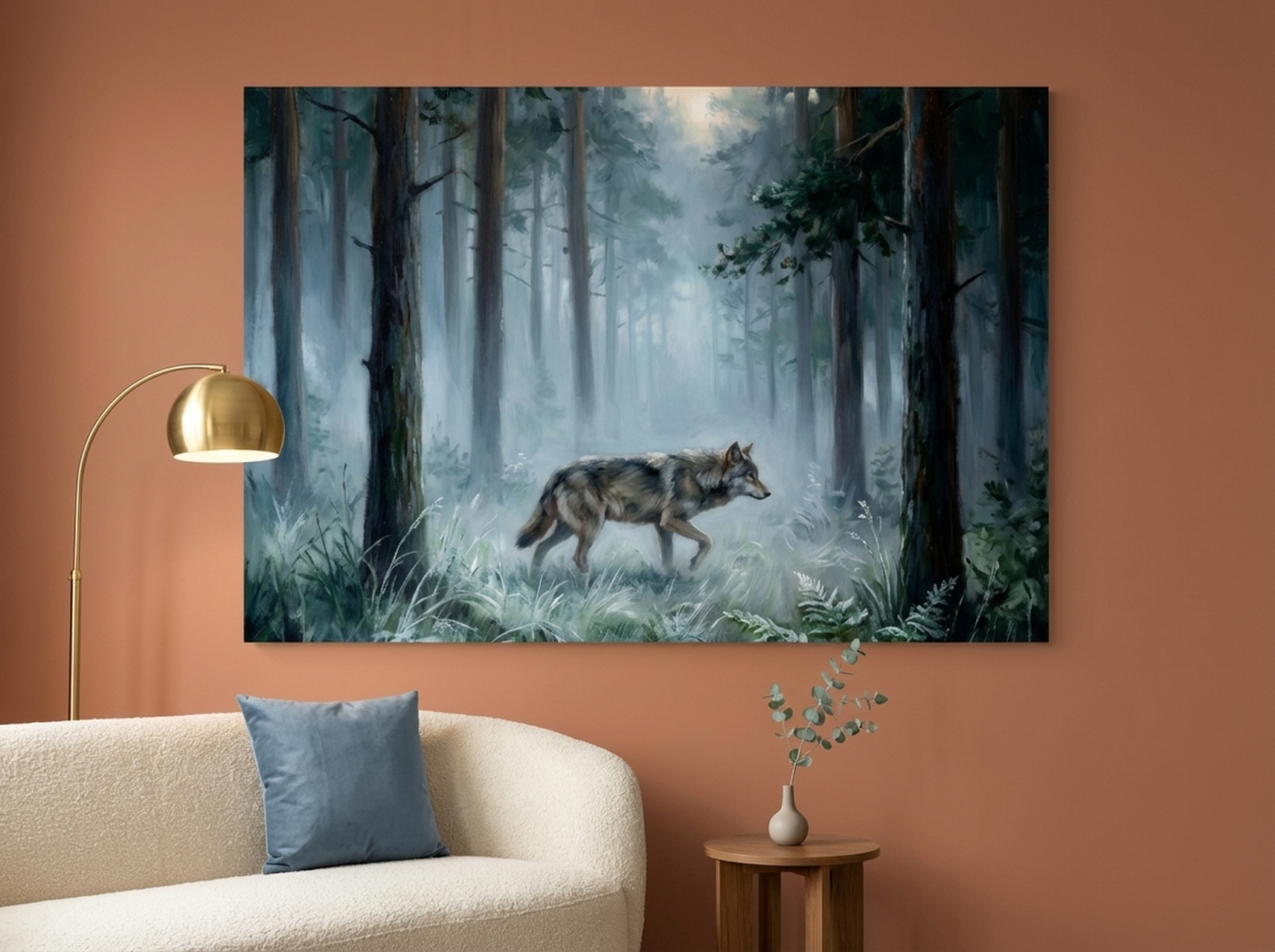
Atmospheric moonlight filters through misty trees as a lone wolf surveys its domain in this hauntingly beautiful canvas print. The cool palette of blues, teals, and silvers works particularly well on matte canvas because the finish prevents the washed-out highlights that glossy paper can produce in dimly lit scenes. The overall effect is moody and cinematic. Hang it in a bedroom or reading nook at 61 by 91 cm (24 by 36 inches), and keep surrounding decor minimal so the piece can breathe and set the room's tone on its own.
View the Wolf Moonlit Forest Painting
Practical Buying Guide: Sizes, Placement, and Lighting
Getting the right print material is only half the equation. Here is how to make sure your canvas looks its best once it is on the wall.
Size Selection by Room
- Above a sofa: Choose a canvas that covers roughly two-thirds of the sofa's width. For a standard 213 cm (84 inch) sofa, that means a canvas around 122 to 152 cm (48 to 60 inches) wide. A single large piece has more visual impact than a cluster of small ones.
- Above a bed: Centre the canvas above the headboard and match approximately 50 to 75 percent of the headboard width. For a queen bed, 76 to 102 cm (30 to 40 inches) wide works well.
- Hallways: Narrower spaces suit portrait-orientation canvases at 41 by 61 cm (16 by 24 inches) or 51 by 76 cm (20 by 30 inches). Space multiple pieces 5 to 8 cm (2 to 3 inches) apart for a gallery look.
- Dining rooms: A single landscape canvas at 61 by 91 cm (24 by 36 inches) creates a focal point opposite the entry door, drawing the eye as guests sit down.
For a complete breakdown of sizing rules, see our wall art size guide.
Hanging Height
The centre of the canvas should sit at 145 to 150 cm (57 to 60 inches) from the floor, which is average eye level. When hanging above furniture, leave 15 to 20 cm (6 to 8 inches) between the top of the furniture and the bottom of the frame. These measurements apply to both canvas and paper prints, but canvas is lighter and easier to reposition if you get it wrong on the first attempt. Our complete hanging guide covers hardware, stud-finding, and level-checking in detail.
Lighting Considerations
Canvas prints perform best under warm, indirect light between 2700 K and 3000 K. Avoid spotlights aimed directly at the surface, which can create hot spots. If your room has strong natural light, position the canvas on a wall perpendicular to the window rather than opposite it. Paper prints behind glass will produce glare on the wall facing the window; canvas will not.
For rooms with track lighting or picture lights, position the light source 30 to 45 degrees above the canvas at a distance of 60 to 90 cm (24 to 36 inches) from the wall. This angle illuminates the texture without washing out the colours.
5 Common Mistakes When Choosing Between Canvas and Paper
- Choosing paper because it is cheaper, then spending more on framing. A paper print priced at 40 dollars can easily cost 150 to 300 dollars after custom framing, mat board, and anti-reflective glass. A ready-to-hang canvas at 80 to 120 dollars includes everything. Do the total math before deciding.
- Hanging paper prints in humid rooms. Bathrooms, laundry rooms, and covered outdoor spaces have humidity levels that will warp unprotected paper within weeks. If you want art in these spaces, canvas with a protective coating is the safer choice.
- Ignoring the viewing distance. If you are choosing paper for its sharper detail, ask yourself: will anyone actually stand close enough to notice? For art viewed from 2 metres (6.5 feet) or more, the detail advantage of paper disappears, but the texture advantage of canvas remains visible.
- Using glossy paper on a wall with windows opposite. Glare makes glossy paper prints unviewable from certain angles. If your art wall faces a window, matte canvas eliminates this problem entirely.
- Buying too small. Both canvas and paper buyers tend to undersize their art. A 20 by 30 cm (8 by 12 inch) print that looked generous on screen will look like a postage stamp on a 3-metre (10-foot) wall. Measure your wall first, then apply the two-thirds rule.
If you are building a multi-piece arrangement, our gallery wall guide walks you through spacing, alignment, and colour coordination step by step.
Frequently Asked Questions
Does canvas or paper show colours more accurately?
Paper prints on a smooth, bright-white surface tend to reproduce colours with marginally higher fidelity in a side-by-side lab comparison. However, in a real room setting with ambient light and viewing distances of 1.5 metres (5 feet) or more, the difference is virtually undetectable. Canvas compensates by adding warmth and depth through its woven texture, which many buyers perceive as richer colour overall.
Can I hang a canvas print in a bathroom?
Yes, with precautions. A canvas print with a protective UV and moisture-resistant laminate can handle moderate bathroom humidity (50 to 70 percent relative humidity) without warping. Avoid hanging it directly above a shower or bathtub where it would receive steam or water splashes. Paper prints are not recommended for bathrooms unless sealed behind glass with a moisture-resistant backing.
How do I clean a canvas print?
Dust the surface gently with a soft, dry microfibre cloth every two to four weeks. For stubborn marks, dampen the cloth with plain water and wipe lightly. Never use household cleaning sprays, solvents, or abrasive cloths, as these can damage the ink and coating. Paper prints behind glass only require glass cleaner on the glazing, not the print itself.
Is canvas or paper better for photographic art?
For ultra-sharp photographic reproductions where fine detail is the priority, paper has a slight edge because its smooth surface preserves every pixel. But for artistic photography, landscapes, portraits, and any image that benefits from a softer, more organic look, canvas often produces a more visually appealing result. Most professional photographers offer both options and recommend canvas for display sizes above 40 by 60 cm (16 by 24 inches).
Do your canvas prints come framed and ready to hang?
Yes. Every canvas print from HEVA Unique Art Gallery ships in a sturdy frame with pre-installed hanging hardware. Choose from four frame colours: black, white, espresso, or natural wood. The canvas is printed on premium matte material and arrives ready to hang straight out of the box.
How long will a canvas print last before fading?
Modern archival canvas prints using pigment-based inks last 75 to 100 years when displayed away from direct sunlight. To maximise lifespan, hang your canvas on a wall that does not receive direct afternoon sun, and keep indoor humidity between 40 and 60 percent. Rotating the art to a different wall every few years can also help distribute any gradual light exposure evenly.
Quick Reference Table
| Product | Best For | Dominant Colours | Link |
|---|---|---|---|
| Norwegian Fjord Mountain Landscape | Living rooms and open-plan spaces | Blue, teal, gold, orange, brown | View |
| Floral Figure Oil Painting | Bedrooms and dressing rooms | Teal, cream, white, terracotta, gold | View |
| Roaring Lion Matte Canvas Print | Home offices and media rooms | Black, gold, orange, brown, yellow | View |
| Abstract Grizzly Bear Emerald Gold | Hallways and gallery walls | Teal, gold, purple, emerald, brown | View |
| Moroccan Medina Lantern Alley | Dining rooms and entryways | Teal, gold, orange, brown, cream | View |
| Wolf Moonlit Forest Painting | Bedrooms and reading nooks | Blue, teal, gray, white, silver | View |
Ready to See the Canvas Difference?
Every piece in our collection is a gallery-quality framed matte canvas print that arrives ready to hang. Free US shipping on all orders.